Samatha cultivates tranquillity: it calms, steadies and unifies the mind. Vipassana cultivates insight: it investigates changing experience clearly. The distinction is one of function, not two rival religions or permanently separate techniques. Theravada teachings develop both calm and insight.

The words are often presented as a choice: “Should I do Samatha or Vipassana?” That question is understandable, especially when modern retreat systems use one term in their name. Yet in the Pali discourses, samatha and vipassanā are qualities to cultivate, and the mature path needs both.
Samatha and Vipassana at a glance
| Samatha | Vipassana | |
|---|---|---|
| Common translation | Tranquillity, calm | Insight, clear seeing |
| Main function | Settles and unifies attention | Investigates experience and its conditions |
| What weakens | Agitation and the pull of the hindrances | Ignorance and attachment to changing experience |
| Relationship | Each strengthens the conditions in which the other can mature | |
This table is a map, not a wall between practices. Calm requires understanding: a meditator learns which ways of attending settle or disturb the mind. Insight requires steadiness: without continuity, investigation easily becomes abstract thought.
The difference is in the intention, not just the object
Two people can sit with the same breath and be training different qualities. One may stay with the breath to make attention quieter, steadier and less scattered: that is a Samatha emphasis. Another may notice how the breath, bodily feeling and reactions arise and change, and how grasping adds stress: that is a Vipassana emphasis. The same practitioner may move between these functions during one session.
This is why labels such as “breath meditation” or “body scanning” are not enough to identify a complete Buddhist method. Ask what the instruction is asking you to learn. Is it building continuity and calm, investigating conditions and impermanence, or deliberately doing both? At Wat Pa Tam Wua, the teacher’s current guidance and the wider ethical setting matter more than choosing a permanent identity.
What Samatha does
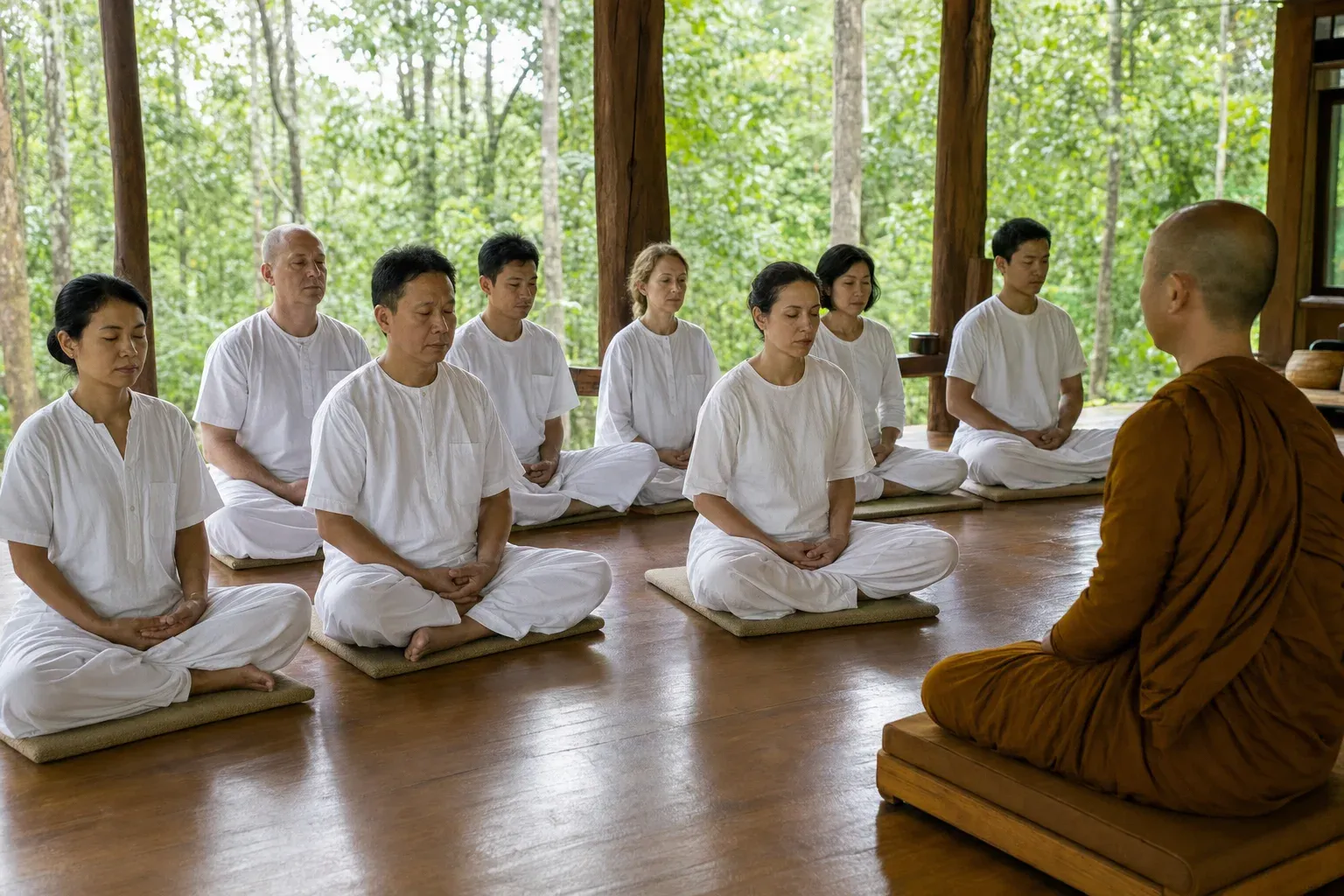
Samatha meditation develops tranquillity. Attention repeatedly returns to a suitable meditation theme—often the breath, loving-kindness or awareness of the body—until it becomes less scattered. The practitioner is not trying to become unconscious or press thoughts out of existence. Genuine calm remains bright, mindful and responsive.
As the five hindrances—sensual desire, ill will, dullness, restlessness and doubt—lose some of their force, the mind becomes more workable. This collectedness can deepen toward samadhi and jhana, but Samatha covers a broader range than absorption alone.
What Vipassana does
Vipassana meditation develops insight or clear seeing. Bodily sensations, feeling tone, states of mind and mental patterns are known as changing events rather than immediately taken as “me” or “mine.” The investigation reveals impermanence, the insecurity of clinging to what changes, and not-self.
Vipassana is therefore more than noticing. Mindfulness keeps experience present; wise attention asks what conditions it, how it changes, and what happens when it is grasped or released. This understanding is experiential, although study and Dhamma instruction help orient it.
The same object can support both
A common oversimplification says that breath meditation is Samatha while observing changing sensations is Vipassana. But the object alone does not determine the function.
With the breath, a practitioner can learn how to settle bodily and mental activity, developing tranquillity. The same practice can disclose change, intention, feeling and the effects of clinging, developing insight. The Buddha’s sixteen-step teaching on mindfulness of breathing in MN 118 includes calming and investigation within one training.
The same applies to walking. Continuous attention to the body can collect the mind; investigation of intention, sensation and change can foster insight. Posture and technique names are less decisive than the quality and purpose of attention.
Which should come first?
There is no single sequence for every practitioner. AN 4.170 describes four routes associated with liberation:
- insight preceded by tranquillity;
- tranquillity preceded by insight;
- tranquillity and insight developed in tandem;
- a mind that becomes settled after restlessness concerning the Dhamma is brought under control.
AN 4.94 makes the practical principle clearer: someone with tranquillity but insufficient insight should learn how to investigate; someone with insight but insufficient tranquillity should learn how to steady and unify the mind. The goal is not to defend a preferred camp but to develop what is missing.
How the balance changes in practice
When the mind is restless
Emphasise calming. Simplify the task, stay with the body or breath, reduce unnecessary stimulation, and let continuity build before attempting subtle investigation.
When the mind is calm but passive
Bring in careful inquiry. Is the calm changing? Is attachment to peace present? What conditions maintain the state? Calm becomes a basis for wisdom when it is known without possession.
When investigation becomes thinking
Return to an embodied anchor. Vipassana is not an internal lecture about impermanence. Directly know the current sensation, feeling and reaction before drawing conclusions.
When concentration becomes dull
Increase energy: straighten the posture, open the eyes or practise walking. Samatha is clear and stable, not a pleasant haze.
Where mindfulness and samadhi fit
Mindfulness, Samatha, samadhi and Vipassana are related but not interchangeable labels. Mindfulness remembers the task and keeps the field of practice present. Samatha is tranquillity. Samadhi is collectedness or unification. Vipassana is insight. Within the Noble Eightfold Path these qualities develop in dependence on right view, ethical conduct and right effort.
This wider context prevents meditation from becoming a search for private experiences. A calm state is evaluated partly by what it supports after the session: less greed, aversion and confusion; more patience, restraint and discernment.
How Wat Pa Tam Wua approaches both
Wat Pa Tam Wua teaches within a Theravada Thai Forest monastery. Walking, sitting and lying-down meditation are supported by chanting, Dhamma instruction, the Eight Precepts, communal responsibilities and periods of individual practice. The entire schedule becomes a training in steadiness and understanding.
Beginners do not need to decide on a permanent meditation identity. Follow the current instruction, observe its effect honestly, and ask a teacher when the mind becomes persistently agitated, dull or confused. If you are planning a stay, read the Wat Pa Tam Wua retreat guide, timetable and rules.